


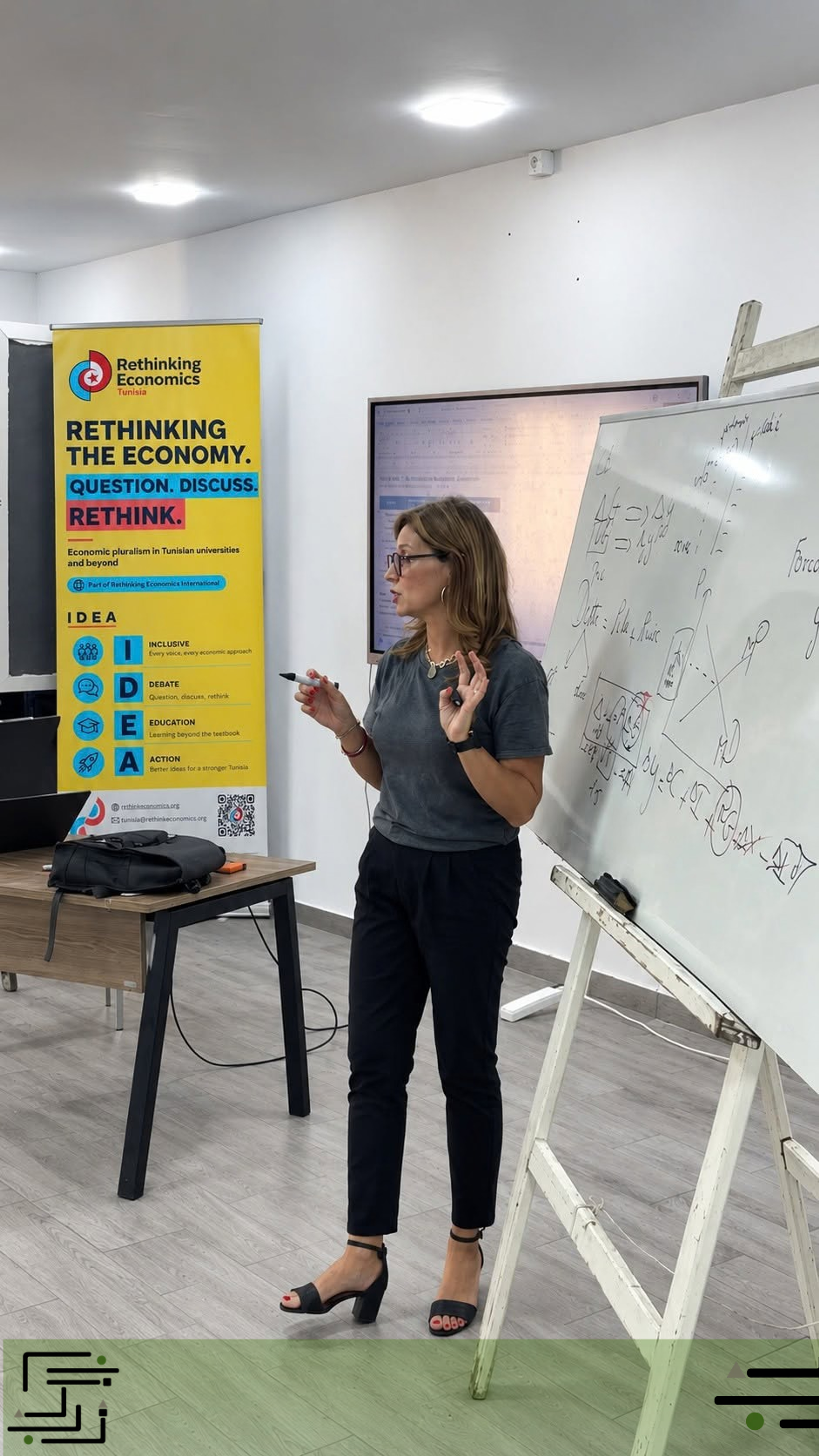
The two-day summer school brought together advanced discussions on fiscal policy, economic activity, public debt, and debt sustainability, combining macroeconomic theory, empirical evidence, critical discussion, and practical applications.
Day 1: Fiscal Multipliers and the Austerity Debate
The first day focused on the fiscal multiplier and the mechanisms through which government spending and taxation can influence economic activity.
Participants examined the factors that can affect the size and effectiveness of fiscal multipliers, including:
- Monetary policy
- Exchange-rate regimes
- Economic recessions
- Financial conditions
- Imports and leakages
- Expectations
- The effective lower bound
The programme then turned to the European austerity debate, examining influential empirical contributions and different interpretations of the relationship between fiscal consolidation and economic growth.
Rather than treating macroeconomic policy as a set of isolated concepts, the session connected theoretical mechanisms with empirical evidence and historical policy experiences.
Day 2: Public Debt Dynamics and Debt Sustainability
The second day focused on public debt dynamics and fiscal sustainability.
Participants explored the standard public debt accumulation equation and examined how interest rates, economic growth, and primary balances interact to determine the evolution of government debt.
Key concepts included:
- Public debt dynamics
- The snowball effect
- Primary balances
- Bohn's approach to fiscal sustainability
- The relationship between interest rates and economic growth
- The debate surrounding r < g
- Long-run debt sustainability
These concepts were connected to sovereign debt experiences in Portugal, Italy, Ireland, Greece, and Spain, providing a historical and applied perspective on public debt management.
The programme also addressed the distinction between sovereign default, debt restructuring, and debt reprofiling, including the Greek debt restructuring of 2012.
From Macroeconomic Theory to Practical Application
A central objective of the summer school was to connect macroeconomic theory with practical analysis.
The programme concluded with an applied component using an Excel-based public debt trajectory simulator. The simulation allowed participants to observe how changes in:
- Interest rates
- Economic growth
- Primary balances
can affect the trajectory of public debt over time.
This practical component helped translate abstract debt dynamics into an interactive framework in which participants could experiment with different macroeconomic scenarios and directly observe their implications.
Building a Research and Learning Environment
For MindGame Research & Consulting Lab, this workshop represents more than an academic event.
It reflects the type of research and learning environment we aim to build: one that connects rigorous economic theory, empirical evidence, simulation, discussion, and practical applications.
Our approach is centered on moving beyond passive learning by encouraging participants to examine economic mechanisms, question assumptions, discuss competing interpretations, and explore how theoretical models behave under different conditions.
Collaboration with Rethinking Economics Tunisia
We extend our special thanks to Rethinking Economics Tunisia for this collaboration and for helping bring together a community of curious, engaged, and intellectually active participants interested in economics and critical discussion.
We are particularly grateful to everyone who contributed to the discussions, asked questions, challenged ideas, and helped make these two days intellectually enriching.
Looking Ahead: The Winter School
The Advanced Macroeconomics Summer School is only the beginning.
The upcoming Winter School will continue this programme with more advanced applications, empirical analysis, simulations, and contemporary macroeconomic questions.
Through these initiatives, MindGame Research & Consulting Lab continues to develop spaces where economics can be explored through theory, evidence, experimentation, simulation, and critical thinking.
MindGame Research & Consulting Lab
Advancing the Science of Human Choice
#AdvancedMacroeconomics #Macroeconomics #FiscalPolicy #FiscalMultiplier #PublicDebt #DebtSustainability #DebtDynamics #AppliedEconomics #EconomicsEducation #Research #SummerSchool #WinterSchool #MindGameResearchLab #RethinkingEconomicsTunisia
References
- 1.Blanchard, O. J., & Leigh, D. (2013). Growth Forecast Errors and Fiscal Multipliers. IMF Working Paper No. 2013/001. International Monetary Fund. https://doi.org/10.5089/9781475576443.001
- 2.Barro, R. J. (1974). Are Government Bonds Net Wealth? Journal of Political Economy, 82(6), 1095–1117.https://doi.org/10.1086/260266
- 3.Alesina, A., & Ardagna, S. (2010). Large Changes in Fiscal Policy: Taxes versus Spending. In Tax Policy and the Economy, Vol. 24, 35–68https://doi.org/10.1086/649828
- 4.Christiano, L., Eichenbaum, M., & Rebelo, S. (2011). When Is the Government Spending Multiplier Large? Journal of Political Economy, 119(1), 78–121.https://doi.org/10.1086/659312
- 5.Bohn, H. (1998). The Behavior of U.S. Public Debt and Deficits. The Quarterly Journal of Economics, 113(3), 949–963.https://doi.org/10.1162/003355398555793
- 6.Blanchard, O. (2019). Public Debt and Low Interest Rates. American Economic Review, 109(4), 1197–1229.https://www.aeaweb.org/articles?id=10.1257/aer.109.4.1197
- 7.Reinhart, C. M., & Rogoff, K. S. (2010). Growth in a Time of Debt. American Economic Review, 100(2), 573–578https://www.aeaweb.org/articles?id=10.1257/aer.100.2.573